
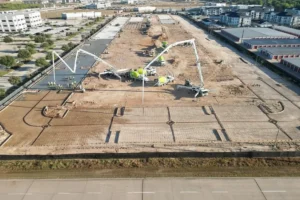
Industrial construction cost in Houston is not one number. Warehouses, manufacturing facilities, distribution centers, cold storage buildings, and renovation projects all carry different cost profiles because they solve different operational problems. Owners who rely on a generic square-foot estimate often end up with budgets that are either too optimistic or too broad to be useful.
The better approach is to understand which cost drivers belong to which building type. In Houston, that means paying attention to site development, drainage, utility infrastructure, paving, structural requirements, process support, and operational intensity. A facility built for movement and throughput will cost differently from one built for storage. A manufacturing building will cost differently from a shell warehouse. A renovation project will follow its own logic entirely.
Why Houston Industrial Costs Need Context
Houston is a high-opportunity industrial market with diverse building demand. The city supports port-related logistics, regional distribution, manufacturing, processing, and redevelopment of older industrial stock. That diversity is exactly why construction budgeting must be specific. The right question is not just “What does industrial construction cost?” but “What kind of industrial facility are we actually building?”
Typical Cost Ranges by Facility Type
- Warehouse construction: often the baseline industrial cost reference point
- Distribution centers: typically cost more when dock counts, circulation, and throughput requirements increase
- Manufacturing facilities: often higher due to utilities, production infrastructure, and specialized floor or structural needs
- Cold storage buildings: significantly shaped by envelope and refrigeration systems
- Industrial renovation: variable because existing conditions drive scope
The same building size can produce very different construction budgets depending on how the facility needs to operate.
Major Cost Drivers in Houston Industrial Projects
Site Work and Civil Requirements
Houston projects often require careful drainage and detention planning. Civil design, utility extension, grading, paving, and soil-related issues can significantly influence the cost before the vertical structure even begins.
Structural and Building Envelope Systems
Clear height, spans, equipment loads, wall systems, roofing, and weather performance all affect cost. A higher-performing building shell may cost more initially but support better long-term operations.
Truck Courts, Paving, and Exterior Operations
Industrial costs are heavily affected by what happens outside the building. Trailer parking, turning radii, loading zones, employee parking, and pavement durability matter, especially for facilities with intense freight activity.
Utility and MEP Complexity
Manufacturing and specialized facilities often require much more than standard lighting and power. Mechanical systems, process piping, ventilation, upgraded electrical capacity, and utility coordination all influence cost.
Interior Finish and Occupant Needs
Office areas, quality control rooms, locker areas, employee spaces, and specialized interiors create a very different cost profile from a basic shell.
Why Renovation Costs Behave Differently
Industrial renovation in Houston is increasingly relevant because many owners want to upgrade existing facilities in strategic locations rather than move. Renovation cost is less predictable at first because it depends on what the building reveals. Structural deficiencies, outdated systems, code upgrades, roof replacement, and layout constraints can all change the final number.
That is why renovation budgets benefit from early investigation and phased scope development. Existing buildings can create value, but only when the real conditions are understood.
Budgeting Mistakes Owners Should Avoid
- Using warehouse pricing for the manufacturing scope
- Ignoring site and paving costs in early estimates
- Underestimating office and employee support areas
- Assuming renovation is automatically cheaper than new construction
- Failing to align the budget with the true operational requirements
How to Build a Smarter Industrial Budget
The best industrial budgets are operationally driven. Start by defining what the building must support: storage, throughput, production, refrigeration, freight intensity, employee needs, or a combination of those. Once the use case is clear, a contractor can help translate operational goals into a realistic construction scope.
In Houston, local knowledge also matters. Cost planning should reflect real site conditions, local permitting realities, transportation context, and how the facility fits within the region’s industrial ecosystem.
Long-Term Cost vs Initial Cost
Owners sometimes focus too much on reducing initial construction spend without considering operational consequences. A slightly cheaper building can become more expensive over time if truck flow is inefficient, utilities are undersized, maintenance is higher, or the layout limits growth. Industrial construction should be measured by performance as much as by first cost.
Comparing Building Types the Right Way
Owners often want one benchmark number for industrial construction, but the real value comes from understanding which building systems are essential for each project type. A warehouse might prioritize shell efficiency and site circulation. A distribution center may spend more on dock infrastructure and paving. A manufacturing facility may devote more budget to electrical capacity, mechanical systems, and internal production support. Once those differences are understood, estimates become more strategic and less generic.
Houston owners should also think about cost in relation to the market position of the asset. A building intended for a premium industrial corridor or specialized operation may justify higher construction spend because the location and use demand more performance. The question is not always how to build for the least money. It is how to build the right level of asset for the market and the operation.
Ways to Improve Cost Accuracy
- Match the estimate to the exact building type
- Separate the base building cost from the site and utility cost
- Evaluate how much freight activity the site must support
- Study renovation conditions before assuming savings
- Use pre-construction input to refine the scope before final budgeting
How KCS Approaches Houston Industrial Content and Planning
Across Houston industrial projects, the same pattern appears again and again: the best results come from early clarity. That means defining the operating goal of the facility, understanding what the site can support, and making construction decisions that reinforce long-term performance instead of creating avoidable tradeoffs. Whether the project involves warehousing, logistics, manufacturing, renovation, or site development, the strongest outcomes tend to come from teams that connect planning, budget, schedule, and operations from the beginning.
That is also why owners evaluating industrial construction topics should be cautious about one-size-fits-all advice. Houston projects are influenced by corridor access, drainage, utility coordination, freight conditions, and the actual day-to-day use of the facility. A practical construction partner helps connect those local realities to building decisions so the finished project works in operation, not just in concept.
For owners, that kind of alignment creates better decisions, fewer surprises during construction, and a finished facility that supports business goals with less day-to-day friction after turnover.
FAQs About Industrial Construction Costs in Houston
What affects industrial construction cost the most in Houston?
Common cost drivers include site development, drainage, utility infrastructure, building type, truck operations, office finish, and specialized systems.
Are warehouses the cheapest type of industrial building?
They are often more cost-efficient than manufacturing or cold storage facilities, but actual cost depends on operations, site needs, and finish level.
Is renovation always cheaper than new industrial construction?
No. Renovation can be cost-effective, but hidden conditions, code upgrades, and system replacement can narrow or eliminate the savings.
How can owners improve budget accuracy?
Define the operational use early, study the site carefully, and coordinate with a construction partner who understands Houston industrial conditions.
KCS Construction helps owners align industrial construction budgets with real facility needs so the project works on paper and in operation.