
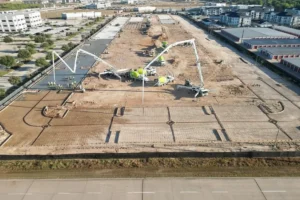
Houston’s industrial growth is inseparable from logistics. The region’s highway network, freight connectivity, and the Port of Houston all influence where industrial buildings are built, how they are designed, and what type of performance owners expect from them. That is why industrial construction in Houston should never be treated like a generic real estate exercise. Location and logistics context shape the building from day one.
For developers and owner-users, the question is not simply whether a site is available. It is whether the property supports the movement of goods efficiently enough to justify the construction investment. In many cases, the logistics context is the reason the project exists.
Why the Port of Houston Matters
The Port of Houston is one of the region’s defining industrial advantages. It supports global trade, container movement, and related freight activity that drives demand for nearby industrial space. Buildings influenced by port traffic often require a different level of planning because throughput, access, and transportation timing become more important.
That does not mean every Houston industrial building needs to sit near the port. It does mean that many successful projects are shaped by how goods move to, from, or around port-related corridors.
How Logistics Context Changes Construction Decisions
Site Selection
A site with direct or efficient access to major freight routes can create substantial value. In Houston, the right location can improve transportation efficiency, reduce delay, and support stronger long-term leasing or operational performance.
Building Type
Port-related or corridor-dependent operations may justify more advanced distribution features, stronger dock strategies, larger truck courts, or layouts optimized for faster throughput.
Site Circulation
Truck flow becomes more important when freight velocity is part of the business case. Poor circulation reduces the benefit of a strong location.
Future Flexibility
Logistics patterns can change. Industrial buildings that are designed with flexibility tend to hold value better because they can adapt to different tenant needs or distribution models.
Logistics Corridors Matter Beyond the Port
Houston’s industrial advantage is not limited to port adjacency. Major corridors such as I-10, I-45, and Beltway 8 support movement across the metro and beyond. For many industrial users, these corridor relationships are just as important as direct port access because they improve regional reach and reduce routing friction.
Construction Should Reflect Freight Reality
A building tied to Houston logistics should be planned around how freight actually moves. That may influence dock count, building orientation, trailer support, circulation, employee access, and even the amount of office space needed. In other words, logistics is not just a location issue. It is a design issue.
What Owners Often Overlook
- Assuming all industrial sites benefit equally from logistics access
- Choosing a site with strong geography but weak circulation potential
- Designing for square footage instead of throughput
- Ignoring how freight intensity affects paving and exterior operations
- Underestimating the long-term value of flexibility
How Logistics Affects Long-Term Asset Value
Industrial buildings in Houston are often judged by how well they support movement. A well-located and well-designed facility can maintain stronger value because it serves real logistics needs, not just building demand. That is particularly true for properties that combine good access with practical site functionality.
Using Construction Strategy to Capture Location Value
The best construction strategies do not merely place a building on a site. They translate location advantages into operating advantages. That means aligning building type, site layout, truck flow, and future adaptability with the logistics role the property is meant to serve.
Turning Logistics Advantage Into Building Advantage
The strongest Houston industrial projects are the ones that translate regional freight advantages into building performance. That means the construction strategy should ask a direct question: how will the property use its location better than a generic industrial building would? The answer may involve faster truck circulation, more effective dock placement, stronger site orientation, or a building type better suited to freight turnover.
When owners align construction with logistics context, the result is usually a stronger asset. The building feels native to the market instead of interchangeable. That kind of alignment matters in Houston because location is often one of the project’s biggest value drivers.
Ways Logistics Should Influence Construction
- Let freight patterns shape site selection and layout
- Design the building for the speed of the operation
- Use truck flow to protect location value
- Match building type to the logistics role of the site
- Preserve flexibility for shifting freight demand over time
How KCS Approaches Houston Industrial Content and Planning
Across Houston industrial projects, the same pattern appears again and again: the best results come from early clarity. That means defining the operating goal of the facility, understanding what the site can support, and making construction decisions that reinforce long-term performance instead of creating avoidable tradeoffs. Whether the project involves warehousing, logistics, manufacturing, renovation, or site development, the strongest outcomes tend to come from teams that connect planning, budget, schedule, and operations from the beginning.
That is also why owners evaluating industrial construction topics should be cautious about one-size-fits-all advice. Houston projects are influenced by corridor access, drainage, utility coordination, freight conditions, and the actual day-to-day use of the facility. A practical construction partner helps connect those local realities to building decisions so the finished project works in operation, not just in concept.
For owners, that kind of alignment creates better decisions, fewer surprises during construction, and a finished facility that supports business goals with less day-to-day friction after turnover.
FAQs About Houston Logistics and Industrial Construction
How does the Port of Houston influence industrial construction?
The port drives freight demand, which increases the value of sites and buildings that can support efficient movement of goods and related logistics operations.
Does every industrial project need to be near the port?
No. Many projects benefit more from strong corridor access and regional distribution reach than direct port adjacency.
Why does logistics context affect building design?
Because throughput, truck flow, dock strategy, and site circulation all change based on how the facility supports freight movement.
Can a strong location still underperform?
Yes. If the site layout, circulation, or building design does not support operations, the logistics advantage may not translate into actual performance.
KCS Construction helps owners turn Houston logistics advantages into practical construction decisions that support operations, tenant appeal, and long-term industrial value.